Your AI CFO: Expensify's Concierge is "real AI" that doesn't suck

By David Barrett, CEO of Expensify. Follow David on LinkedIn.
I know we're all sick of talking about AI. It's everywhere, whether we like it or not.
Every photo looks a little too perfect. Every email is a little too friendly. The news whiplashes between AI cracking the next unsolvable puzzle, and then making deepfakes with too many fingers. My toothbrush literally smiles at me if I do a good job.
Everything is happening, all at once. On the path to this glorious AI future, we are wading through oceans of AI slop. It's all so new, everyone is throwing it at the wall to see what sticks, and it's very messy for everyone in the process.
Most of today's AI products probably won't survive contact with reality. But underneath all the slop, there's something real. And for finance leaders, that something is starting to matter a lot.
The AI CFO isn't a robot that replaces your finance team. It's what happens when the right financial automation tools free your finance leaders from the administrative grind and give them the time, data, and clarity to do the work that actually moves the business forward.
Key takeaways
- The CFO role is shifting from manual financial oversight toward strategic leadership supported by automation and realtime data insights.
- AI-powered finance tools help reduce administrative workload across expense tracking, reconciliation, and reporting workflows.
- Predictive analytics and automated controls enable faster, more informed financial decision-making in complex operating environments.
- Modern finance leaders increasingly act as technology enablers, driving the adoption of systems that improve operational visibility and governance.
AI is the new Y2K
This anecdote dates me a bit, but today feels a lot like the original dotcom boom, which balanced excitement for the "information superhighway" against cataclysmic fears of "Y2K" (where every clock's year went from 99 to 00, which created massive fears of societal collapse… yes, really). Back then, all it took was an "e" at the front, a ".com" at the end, and voila – a billion-dollar company.
Then came the crash, which wiped out most of those companies for reasons that were completely obvious even while they were happening: massive overspend to get ahead of demand that never materialized, with impossible unit economics.
However, there was something genuinely transformational underneath all the hyperbolic dotcom hype that survived. Yes, eToys, Pets.com, WebVan, and Kozmo were epic fails. But e-commerce and same-day delivery were good ideas – and Amazon figured out how to make it work at a staggering scale.
A transformational moment for AI
What's happening today feels similar.
Sure, most of today's AI startups (and some of the giants) are probably going to crash and burn: spending $15 on infrastructure to generate $1 in revenue rarely ends well. Social networks for AIs to talk to other AIs are just elaborate performances to nobody.
But underneath all that hype is something truly transformational – once you peel back all the many (many!) layers of BS. And somebody is going to take the time to make it actually not suck. Spoiler: we're working very hard to ensure that someone is us.
For finance leaders, that moment is already here. The question isn't whether AI belongs in your financial operations but whether you're using it in a way that actually earns the name.
Why the CFO role is evolving
The job has gotten harder. Finance teams are dealing with more data, faster decision cycles, distributed teams, and decentralized spending, all at the same time. According to PwC, nearly nine in ten CFOs say implementing technology to improve capabilities is a priority for their function.
The old playbook with monthly reports, manual reconciliation, and spreadsheet forecasting wasn't built for this environment. AI is what makes expense management actually scale with the business.
From financial gatekeeper to strategic technology leader
CFOs used to be the people who said no. Cost control, reporting accuracy, audit readiness… sure, it’s important work, but fundamentally reactive.
The modern CFO influences which technology the business adopts, how operational workflows are structured, and how the company scales. That's a fundamentally different job. And it requires fundamentally different tools than the ones most expense reports were built around.
How to identify "real AI"
One major complication of any discussion about AI is that it's a marketing term, not a technology. There's no strict definition of what qualifies, so it tends to be applied generously, like thick syrup over day-old pancakes.
What we previously called "automation”, "algorithms," "rules engines" – basically anything with an if/then statement – has been rebranded "artificial intelligence". For finance leaders trying to cut through the noise, that distinction matters a lot.
For those terms to mean anything at all, AI needs to align with the 5 C’s:
Conversational – Quite simply: it needs to be able to talk with you, in natural language, either by chat or voice (ideally both). Language is the most classic hallmark of intelligence, artificial or otherwise.
Contextual – It's got to know more than you. If you need to bring it up to speed (ie, copy/paste, drag/drop, download/upload), then it's slowing you down.
Capable – It needs to do more than just talk. The AI buzzword for this is to call it "agentic", meaning it acts as an agent to take actions on your behalf, not just a sounding board for ideas that you need to execute yourself.
Continuous – It's got to work while you sleep. A tool that makes you smarter is great, but true intelligence requires operating on its own.
Correctable – Finally, it's got to learn from its mistakes. Anything that can't explain what it did, understand why it was wrong, or accept instructions on how to do it right, can't honestly be considered "intelligent".
Each of these seems pretty common sense, and the big players qualify pretty easily (ChatGPT, Gemini, Claude, etc.). But outside of that… the list starts to get really thin (and in our industry, almost nonexistent).
Don't get me wrong; canned reports, pretty dashboards, and customizable rules engines – those are all great. But anyone claiming those are "intelligent" is kinda stretching the meaning of that word.
Concierge is the only "real AI" in the industry
You knew where this was going, didn’t you? Here's where I try to explain why Concierge is the only "artificial intelligence" in the expense management industry that actually earns that title (and why it’s not just an AI for CFOs, but for everyone tracking expenses).
Concierge is conversational
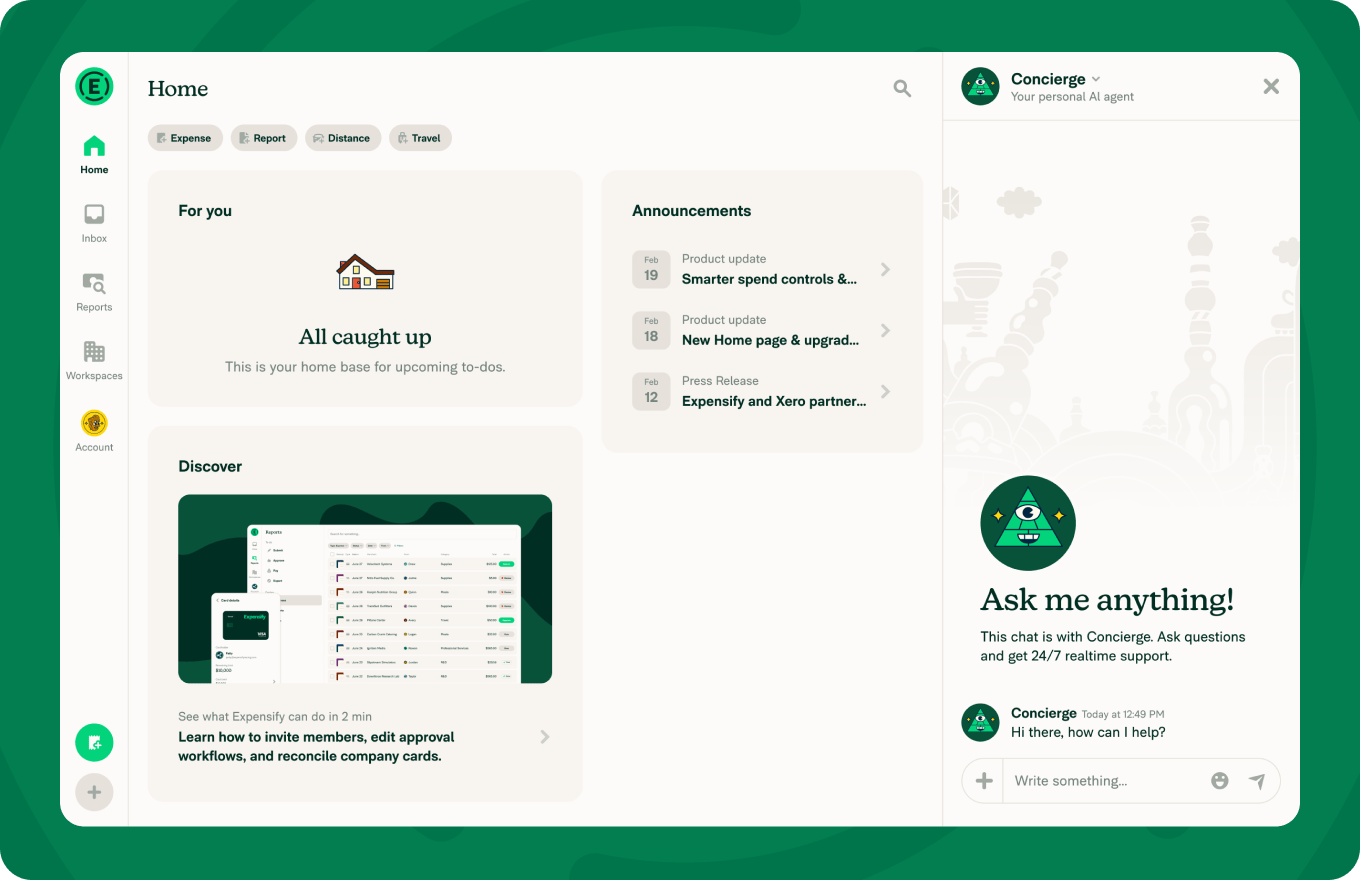
Concierge is your conversational AI personal assistant, available on every page to answer any questions you have about Expensify, how to configure it, and how to use it.
Concierge is contextual
New Expensify is built with a pretty radical "chat first" design, where every expense, report, invoice, bill, workspace – basically any object in the database – is a chat.
This is, of course, great for collaborating with coworkers (or anyone you want to tag via email or SMS), but it works especially well with Concierge right inside the context of a specific expense – no copy/paste needed!

Concierge is capable
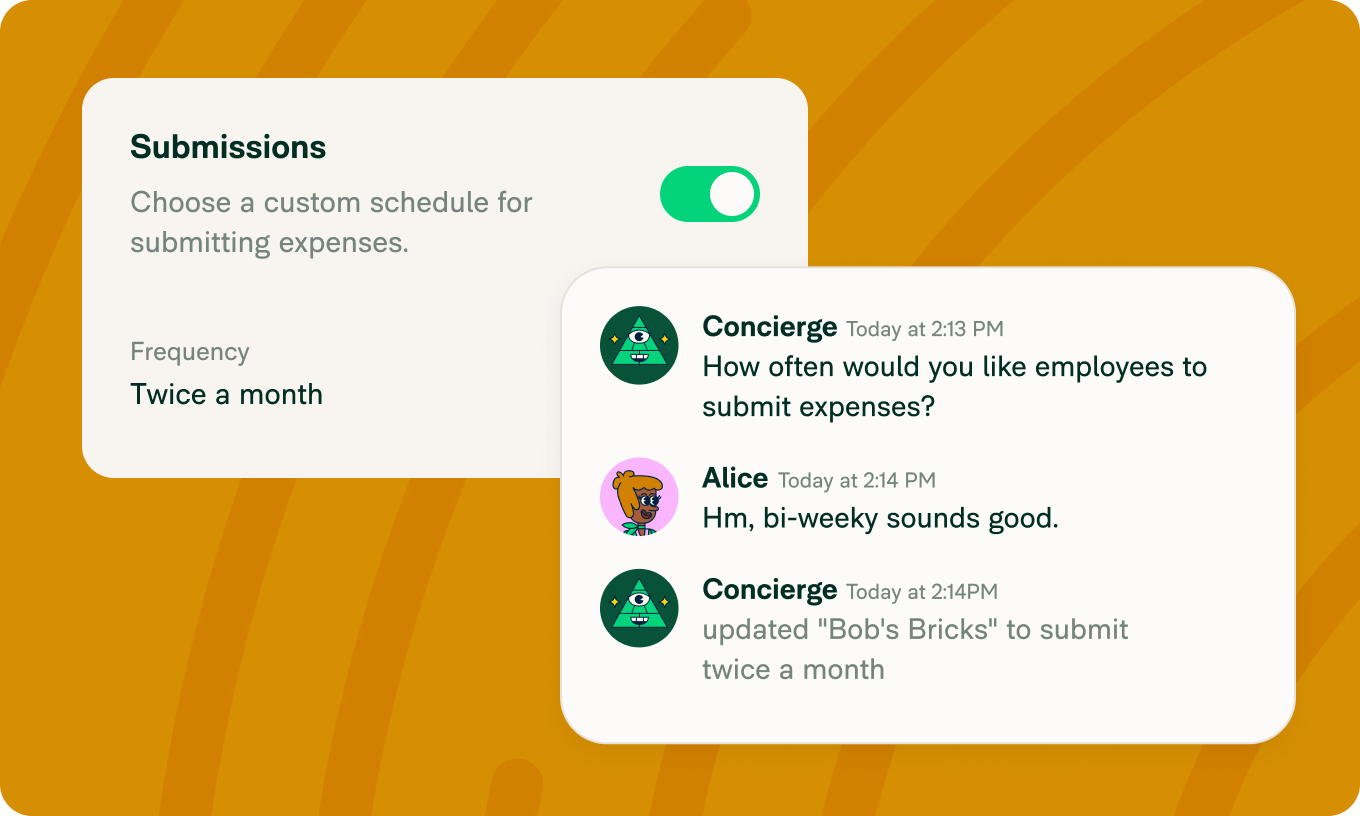
Concierge can already configure workspaces and manage expenses, and is learning new skills every day. Just ask Concierge and see what happens. If it can't already do it, it'll give detailed instructions for how you can do it yourself!
Concierge is continuous
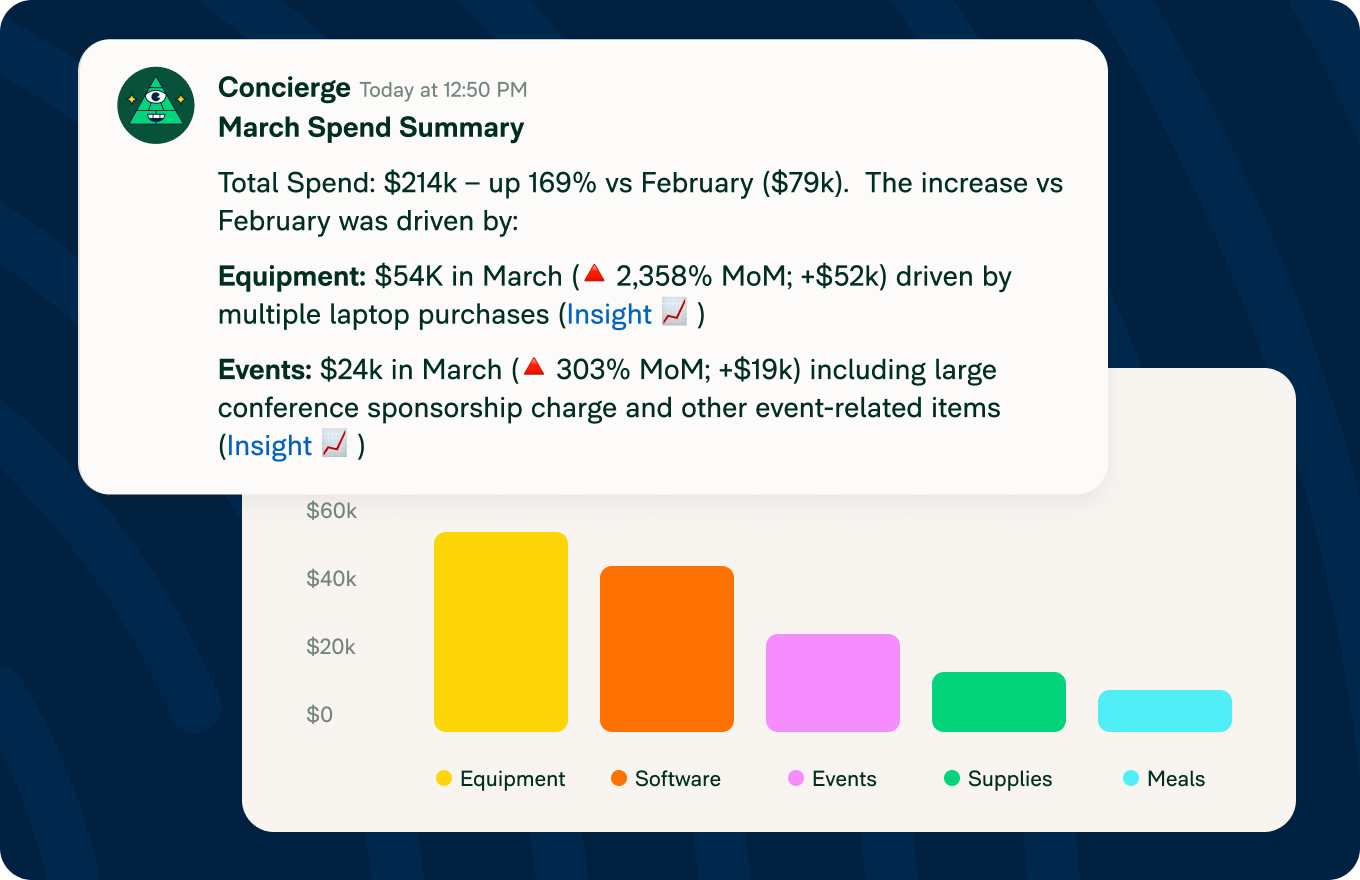
The thing about data is there's so much of it, and so many ways to analyze it. Practically speaking, you can't reasonably do a full set of flux analyses for every employee, category, and merchant, every month… but Concierge can.
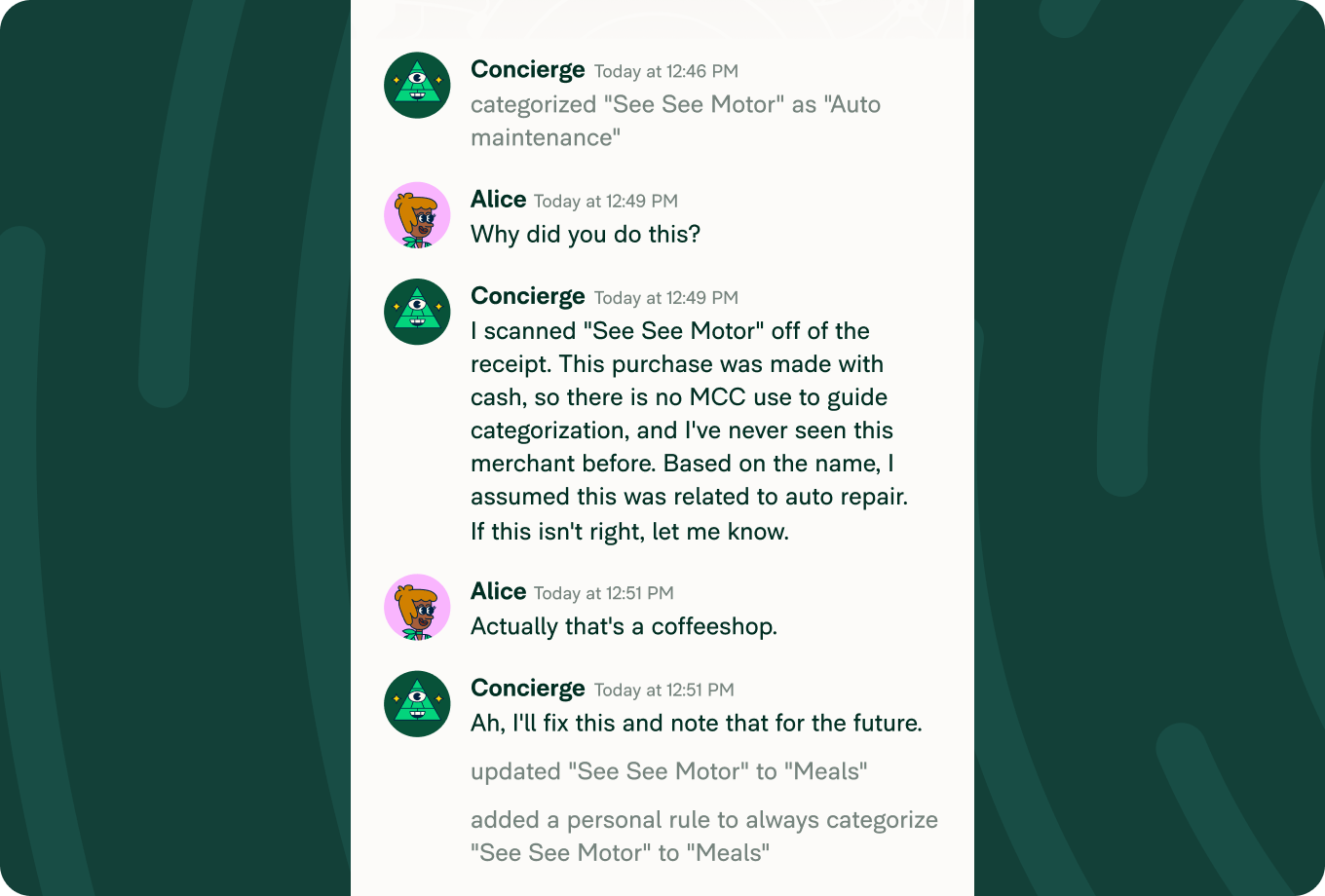
Concierge is correctable
Self-configurable rules engines are great… until something goes wrong, and it’s up to you to figure out why (and how to fix it). Let Concierge handle the debugging by asking why it did whatever it did, and if necessary, to do it differently next time.
What's next for Concierge AI?
Though Concierge is already the most powerful AI in the expense industry, it's only a preview of what's to come. In the near future we aim to have:
Full UI equivalence. Our goal is to make Concierge able to accomplish anything using AI that you can do with the UI. For Concierge to feel like a member of your team, Concierge can't refuse a reasonable request.
Fully self-diagnosing. There are currently some automatic functions that it can't explain well, or reconfigure if it did them wrong. We are steadily working through each to ensure that Concierge can fully explain anything it does, diagnose how it went wrong if you don't like it, and reconfigure itself to do it better next time.
Fully discreet. This is a very tricky balance, and we're extremely cognizant of coming off as "Clippy 2.0". But Concierge should ideally appear when needed to proactively take chores off your plate, without ever feeling disruptive.
Fully informed. Last but not least, we're still integrating every last bit of data into Concierge, such that it can confidently and accurately answer questions about your expenses, workspaces, corporate cards, travel booking, and so on. Concierge is already extremely functional, but there's a lot to cover, and we're steadily filling in the remaining cracks.
In other words, priority number one is perfecting what we think is the "table stakes" experience of a truly intelligent agent. After that… well, this is only the start.
Why AI-driven expense automation is becoming essential for modern CFOs
The finance leaders who will define the next decade aren't waiting for AI to prove itself. They're already using it to get out from under the administrative work that's been quietly consuming their teams for years – the receipts, the reconciliations, the month-end scramble that never seems to get any shorter.
AI-powered expense automation gives CFOs realtime visibility into how money moves through the business, enforces spend controls without creating bottlenecks, and scales financial governance as the company grows. Less time chasing data means more time actually using it.
That's what Expensify is built for. And as AI continues to reshape financial operations, the CFOs who move now will be better positioned to lead not just leaner teams, but smarter ones.
Thanks for reading all the way to the end. It's a pretty dynamic time right now, for a whole host of reasons. I really appreciate the opportunity to help you navigate these turbulent times and come out on top.
-david
Founder and CEO of Expensify
PS: Please follow me on LinkedIn as I've started posting more regularly there!
FAQs about AI CFOs
-
An AI CFO isn't a product or a job title. It's a way of describing a finance leader who uses automation and AI-powered tools to work faster and more strategically.
For SMBs especially, where finance teams are often lean and wearing multiple hats, AI tools that handle receipt capture, expense tracking, and reconciliation automatically can free up significant time for higher-value work.
-
AI supports the CFO function in a few key ways: automating repetitive tasks like data entry and reconciliation, providing realtime visibility into company spending, flagging anomalies and policy violations as they happen, and enabling more accurate forecasting through predictive analytics.
The goal isn't to replace financial leadership but to give finance leaders better tools to do their jobs.
-
No. AI handles the transactional and administrative work that consumes finance teams' time, but the strategic judgment, stakeholder relationships, and decision-making that define great financial leadership aren't automatable. If anything, AI makes the CFO role more valuable by clearing space for the work that actually requires human expertise.
-
AI can automate significant portions of financial operations like expense tracking, reconciliation, reporting, anomaly detection, and forecasting support. But financial management as a discipline still requires human oversight, strategic thinking, and accountability.
AI is a powerful tool within that framework, not a replacement for it.
-
The best AI finance tools are the ones that are conversational, contextual, capable, continuous, and correctable rather than dashboards or rules engines with a fresh coat of paint.
Expensify's Concierge, an AI for CFO leaders, financial teams, and anyone looking to track their expenses, is built around all five of those qualities, making it one of the few AI tools in expense management that genuinely earns the name.